
Quick answer: A murder mystery dinner at home is a sit-down meal where the game and the food run on the same clock: each course opens a new round, guests play suspects between bites, and the killer is named over dessert. You need a kit with a host guide, a make-ahead menu of three courses, and about two hours.
A made-up scene to set the mood: Six people are halfway through the soup when the host sets down her spoon and reads that the bride's father has been found at the foot of a ladder in the barrel room. The caterer freezes, bread basket in hand. The best man, whose card says only that he "left the tent for ten minutes," develops a sudden interest in his napkin. The soup goes cold until the first round of questions ends.
Key takeaways
- The difference between a murder mystery dinner and a murder mystery night is timing: at a dinner, the courses are the rounds.
- Three courses map neatly onto three game rounds: arrivals and starter, the crime and the main, the accusation and dessert.
- Cook everything ahead. The host reads narration and hands out clues, so there is no time to stand at the stove.
- Plan about two hours for 6 to 9 guests; smaller tables finish faster, bigger tables need more talking time.
- No role-play kit for two or three people? A case file works as a dinner too, with one envelope of evidence per course.
What is a murder mystery dinner?
A murder mystery dinner is a murder mystery party played at the table. Guests still get characters, secrets and clues, and one of them is still the killer. The difference is that the meal is the skeleton of the evening: each course signals a new round, and the host serves the next clue with the next plate.
Eating and investigating fit together better than you would expect. People are already seated, facing each other and talking. A plate gives shy guests something to do with their hands and loud guests a built-in pause between accusations.
For the general rules first, read how murder mystery parties work. This guide covers only the dinner version: keeping food and game in step.
Murder mystery dinner vs murder mystery night
People swap the two names freely, but they are different evenings to plan.
| Murder mystery dinner | Murder mystery night | |
|---|---|---|
| Where guests are | Seated at one table most of the time | Standing, mingling, moving between rooms |
| What sets the pace | The courses | The host's timer |
| Food | Three plated courses, made ahead | Finger food and a drinks station |
| Best group size | 4 to 9 guests | 6 to 20 guests |
| Clue trading | Across the table, everyone hears | In corners, in pairs |
| Good for | Date nights, small friend groups, family dinners | Birthdays, big parties, office events |
A dinner is more intimate and easier to host alone; a night is louder and scales better. With more than ten guests, follow our guide on how to host a murder mystery night instead, and keep the food standing.
What happens at a murder mystery dinner, from the guest's chair
At a murder mystery dinner, you arrive as a character, sit down to a meal, learn between the starter and the main that someone in the story has died, spend the main course questioning the people around the table, and write down your accusation before dessert, when the host reads who really did it. That is the whole shape; the rest is texture.
What to expect before you arrive
Expect your character a few days early, usually a short public description you can share and a secret only you know. Read both beforehand. There is nothing to memorise; your booklet comes to the table. The host will likely ask about allergies and may suggest a dress style.
What to expect at the table
Expect a slow, talkative meal with interruptions. Each course brings a short announcement from the host and a new page of information, some worth sharing, some worth hiding. People will question you with a fork in hand, and you will be suspected at least once even if innocent. Most guests find the first ten minutes awkward and the rest easy, because the food fills the gaps between accusations.
What to expect at the end
Expect a deadline: pens down before dessert, a written accusation, then the reveal. The killer usually explains themselves while everyone eats. The conversation afterward often outlasts the game, as guests compare what they knew and when.
What to wear to a murder mystery dinner
Wear what your character would wear to that dinner, from the waist up. At a seated meal, people see only your top half for most of the evening, so a jacket, a shirt collar, a necklace, a hat or glasses does more than shoes or trousers ever will. Stay practical: long sleeves and dangling accessories find the sauce fast.
- Period dinners: one era signal is enough: a bow tie, pearls, a cardigan or slicked hair.
- Modern dinners: dress as the character would for the event in the story. A rehearsal dinner means smart casual; a business dinner means a blazer.
- Keep a pocket free for your booklet and a pen, or a small bag on the back of your chair.
How the courses become rounds
Most role-play kits are written in rounds: an arrival round, a round where the crime is announced, one or two rounds of new clues, then the accusation and reveal. Our murder mystery party kits follow this shape and run about 1.5 to 2.5 hours depending on the size you choose. This is how those rounds sit on a three-course dinner.
Drinks and arrivals: Round 1
Guests arrive, get a drink and read their public page. Before anyone sits, the host asks everyone to introduce themselves in character. This is the only standing part of the evening and should take about 15 minutes. Hold the food; nobody can juggle a plate and a character sheet.
Starter: the crime
Everyone sits. As the starter goes out, the host reads the narration announcing the death. Guests open their first clue page and the table tackles the case's first question. Keep the starter small and cold: a salad, a soup ladled from one pot, bread and dips. Nothing that needs timing.
Main course: the twist
Clear the starter, serve the main, and hand out the round that changes everything: the blackout, the telegram, the hidden letter. This is the longest round, usually 40 to 50 minutes, about as long as a main course takes to eat. The host releases evidence cards one at a time, never all at once, so there is always something fresh to argue over.
Dessert: the accusation and the reveal
Before dessert is served, everyone writes down who they think did it. Then the host brings out dessert and reads the solution while people eat. The murderer explains themselves over coffee. Awards, if your kit has them, are handed out with the last bite.
Planning the menu around the game
The menu rule is simple: the host is never in the kitchen while a round is running. In practice:
- Everything is made before the first guest arrives. A braise, a lasagna, a roast that rests. Nothing that is "just ten minutes" at the end, because those ten minutes are when everyone needs you.
- Starter cold, main warm, dessert cold. Only one course needs the oven, and it goes in during the arrival round.
- Serve family style. Put the main on the table in big dishes and let guests pass them. The host stays seated and suspects get a reason to talk.
- One themed drink, not six. Name it after the victim or the murder scene, mix a pitcher in advance, and leave it on a side table.
- Allergies and vegetarians in writing. Ask when you send the characters, not at the door.
Themed menus are optional. A 1920s speakeasy case does not need a 1920s dinner. A good lasagna and a good story beat an authentic, stressful menu every time.
Setting the table for a mystery
A few small touches turn the table into a scene:
- Place cards with character names, not real names. Seat the characters who have reasons to argue across from each other, not side by side.
- A folder or envelope at each seat for that guest's pages. It keeps secrets secret and keeps sauce off the clue that solves the case.
- A clue tray near the host with the evidence cards in round order, face down.
- Pens at every seat for notes and the final accusation.
- Low light, one candle per two guests. Bright enough to read by, dim enough to feel like something is about to happen.
Our kits give every guest a character file with a public page and a secret page, and some kits, like Murder at the Gilded Canary and Murder at the Midnight Show, also include a printable invitation. Print public and secret pages double-sided and fold them, so a guest can read their own secret without flashing it to a neighbour.
Which kit size fits your table?
The chair count decides the size of the game. Our party kits come in three sizes in one purchase, and the host does not play.
| Table | Kit size | Guests | Playing time | Courses |
|---|---|---|---|---|
| Kitchen table | Mini | 4 to 6 | About 1.5 hours | Two courses can be enough: main and dessert |
| Dining table | Classic | 6 to 9 | About 2 hours | Three courses |
| Two tables or a long one | Grand | 10 to 20 | About 2.5 hours | Buffet main, plated dessert |
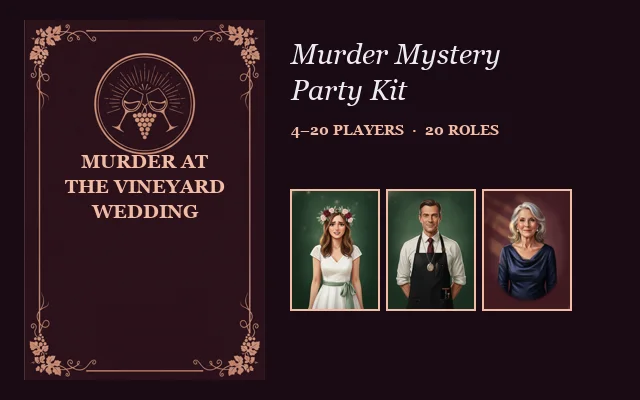
For a dinner inside a dinner, Murder at the Vineyard Wedding is set at a rehearsal dinner the night before a wedding, so the story and your table are the same place. Guests play the wedding party, each has a one-line toast to read in Round 1, and the father of the bride dies just before his.
How we make our kits: every party kit ships with a host guide, and the host keeps the solution sealed until the final vote, so the person serving dessert does not know the ending either.
A murder mystery dinner for two or three
Role-play kits need at least four guests, because someone has to be the killer and three people cannot hide a secret from each other for long. For a date night or a dinner with one other couple, run a case file dinner instead.
Take a printable cold case, split the documents into three envelopes and serve one per course. Starter: the police report, the crime scene and the first statements. Main: the rest of the witness statements, the receipts and the phone records. Dessert: the forensic report and the interrogations, then the accusation, then the sealed solution. Our printable murder mystery case files are written for 1 to 6 players and take 2 to 3 hours, which means a long dinner and plenty of coffee. Nobody plays a character, nobody hosts, and everyone argues over the same evidence.
If printing is too much for a weeknight, an online case on one tablet in the middle of the table does the same job in 20 to 45 minutes, and the first case is free.
Timeline for a two-hour murder mystery dinner
- Two days before: send characters and the invitation. Ask about allergies. Tell guests one prop is enough; a dinner needs no full costume.
- The afternoon: cook the main, make dessert, set the table with place cards and folders, sort the evidence cards into round order.
- 7:00 Arrivals: drinks, introductions in character. Main goes into the oven to warm.
- 7:15 Starter and the crime: narration, first clue pages, first question.
- 7:45 Main and the twist: the big round. Evidence cards go out one by one.
- 8:35 Accusations: everyone writes a name before dessert leaves the kitchen.
- 8:40 Dessert and the reveal: solution, confessions, awards.
- 9:00 Coffee and the debrief: who knew what, who lied best, who was wrong about everything.
Mistakes that ruin a murder mystery dinner
- Serving all the clues with the starter. Guests solve it by the main and sit idle over dessert. Hold cards back.
- A menu that needs the host. If you are plating, you are not hosting. Family style, always.
- Letting the accusation drift. Set a hard moment: pens down when dessert comes out.
- Seating couples together. They whisper real information and the tension leaks away.
- Reading the solution yourself before the party. Keep it sealed. A host who does not know the ending enjoys it as much as anyone.
FAQ
What is a murder mystery dinner?
A murder mystery party played at the table, where each course of the meal opens a new round of the game. Guests play suspects, a host reads the story and hands out clues between courses, and the killer is named over dessert.
How many people do you need for a murder mystery dinner?
Role-play kits need at least four guests plus a host; six to nine is the sweet spot for one table. For two or three people, use a printable case file or an online case instead of a character kit.
How long does a murder mystery dinner take?
Plan about two hours for a three-course dinner with 6 to 9 guests. A kitchen-table game for four runs closer to 1.5 hours; a dinner for 10 to 20 guests takes about 2.5 hours.
What food do you serve at a murder mystery dinner?
Anything you can make ahead and serve family style: a cold starter, a braise or baked main, a dessert from the fridge. The host should never be at the stove while a round is running.
What do you wear to a murder mystery dinner?
Wear one or two items above the waist that tell people who your character is, like a jacket, a collar, a necklace, a hat or glasses. Guests see your top half for most of a seated dinner, so skip the full costume.
What happens at a murder mystery dinner?
Guests arrive as characters, the host announces a death at the start of the meal, each course brings a new round of clues and questions, everyone writes down an accusation before dessert, and the host reveals the killer while dessert is served.
Can you do a murder mystery dinner at home without a kit?
You can write your own, but it takes weeks to make a case that is fair and solvable. A printable kit supplies the characters, the clue schedule and a host guide, so your effort goes into the dinner itself.
What does a murder mystery dinner consist of?
A murder mystery dinner consists of a meal of two or three courses, a cast of guests who each play a suspect, a host who reads the story and hands out clues between courses, and a final accusation and reveal, usually over dessert.