
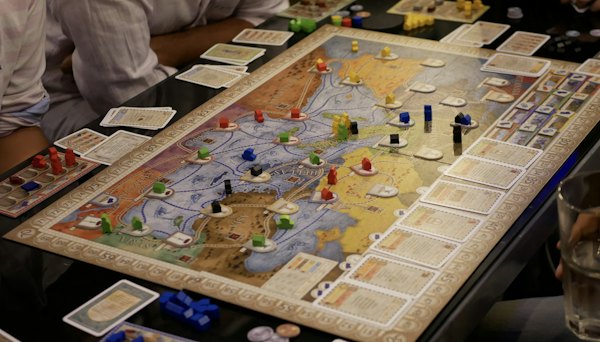
Quick answer: Mystery and detective board games come in a handful of types: classic deduction games with a hidden answer, case-book games where you read and choose leads, app-assisted investigations, multi-night campaigns, social deduction games, and short picture or card-deck mysteries. Choose by play time, group size and how much reading your table enjoys, and the right game usually follows.
A scenario: Four friends stand at the mystery shelf of a board game café for ten minutes. One wants something done by closing time, another wants a story that lasts all winter, and a third refuses anything that needs a phone. They settle on a short card-deck case with a small illustrated scene. By the third case nobody has glanced at a screen, and they are already plotting a longer one for next month.
Key takeaways
- Most detective board games fit one of six types: classic deduction, case-book, app-assisted, campaign, social deduction and quick-play.
- Story-driven cases can usually be solved only once. Value them as one great evening, not a forever game.
- Before buying, check group size, play time, reading load, app needs and how dark the theme gets.
- Paper case files and hosted party games cover nights a board cannot, like solo evenings or groups of ten.
Tabletop mystery keeps growing, and the shelf now holds some of the most inventive detective designs ever boxed. Instead of a ranking, this guide sorts mystery and detective board games into the types players keep returning to, explains what each asks of your group, and offers a simple way to choose. Buying for people who have never played one? Our guide on detective games for beginners narrows the choice further.
What to Look For in a Detective Board Game
Before comparing types, know what makes any mystery game worth the box.
- Fair clues. The solution can be proven with two or three specific pieces of evidence, not guessed. Misleading clues need an innocent explanation you could have found.
- A clear accusation. You know when the investigation ends and what to name: who, how, why, or all three.
- A difficulty curve. Multi-case boxes often open with an easier one. Play it first, even if it looks simple.
- Play time that fits your evening. A case that runs past midnight ends in sleepy guessing.
- Player count that really works. The number on the box is a maximum, not always the best count. Document-heavy games often peak at two to four.
- Replay value. Random hidden answers replay well; story cases are spent once you know the culprit.
- Accessibility. Reading load, language level, small print and color-based clues all matter for some players.
- Price model. One box, a box plus expansions, a mail subscription or a one-off download. Think in cost per evening.
The Six Types of Mystery Board Game
Classic deduction games
The format most people picture: a secret answer is set at the start, and players make suggestions and strike possibilities on a grid until someone names it. Story is thin, but these games drill the genre's core habit: ruling things out instead of guessing. Because the answer changes every game, they replay well and suit families.
Case-book detective games
No board, no pawns. You get a booklet of numbered paragraphs, a map, a directory and often a newspaper, and you decide which addresses to visit. At the end you answer questions and compare your lead count with the ideal route. It is the closest a box gets to reading a detective novel as a group, and it rewards one good reader, one note-keeper and a table that likes to debate.
App-assisted investigations
These pair cards or a board with a companion app. You scan a location or character, and the app reveals what you learn, plays ambient sound and tracks time. Apps can branch a story in ways a booklet cannot. The catch: someone must keep a phone charged and in view, and the screen joins the table.
Campaign games
Multi-session games where cases link into a larger story, and early choices can matter later. Some include an online database of records to search. They play like a TV detective series but need a steady group. Before starting one, ask honestly if the same people will be free every other week.

Social deduction and cooperative party mysteries
Not every mystery game runs on documents. In social deduction games, one or more players secretly know the answer or secretly are the culprit, and everyone else argues out loud to find them. The folk games Mafia and Werewolf are the best-known examples. Some cooperative designs give one player the answer but allow only hints through pictures or tiles. These play like party games and suit bigger, louder tables.
Quick-play mysteries
Short card-deck cases, picture-search games on a big illustrated map and escape-style card games deliver a full mystery in under an hour, which suits cafés, travel and weeknights. Escape-style games lean more on codes than deduction, so check which you want; our piece on escape rooms versus detective games explains the difference.
Our Games That Fit These Types
We do not make board games, but several of our printables and online cases sit beside them on a mystery fan's shelf.
- Printable cold case files. Our printable cold case files give you the paper case file without a box: around 24 to 37 documents depending on the case, six suspects and sealed envelopes or a solution file, for 1 to 6 players over 2 to 3 hours. The solution waits in the last envelope.
- A short printed mystery. If you like the quick-play length, The Last Ferry is a printable mini murder mystery for 1 to 4 players: five evidence documents and six linked puzzles, done in 30 to 45 minutes.
- Party kits. For tables too big for any board, a murder mystery party kit casts every guest, from 4 to 20 players. The host guide keeps the solution sealed until the final vote.
- Online cases. To see if your group enjoys document-heavy cases before buying a big box, try a case in your browser. Each runs in seven stages with a single accusation.
Comparison: Detective Board Game Types
| Game type | Players | Time | Best for |
|---|---|---|---|
| Classic deduction game | Small to mid groups | Under an hour | Families and first-timers |
| Case-book detective game | 1 to about 4 | An evening per case | Readers and debaters |
| App-assisted investigation | 1 to about 4 | About an evening | Groups who like sound and atmosphere |
| Campaign game | A steady small group | Several nights | Regular game groups |
| Social deduction game | Larger groups | Short rounds | Parties and bluffing |
| Quick-play card or picture mystery | 1 to about 4 | Under an hour | Short nights, cafés, travel |
| Printable cold case file (ours) | 1 to 6 | 2 to 3 hours | A full case night at home |
| Murder mystery party kit (ours) | 4 to 20 | A dinner party evening | Big groups and celebrations |
How to Choose: Five Questions
- How many people will actually play? Two to four suits most investigation games. Six or more points to social deduction or a party kit.
- How long is your evening? Under an hour means quick-play or classic deduction. A full evening opens case-book games and case files.
- How much does your table like reading? Heavy readers love case-books; fidgety groups prefer pictures, cards or talk.
- Screen or no screen? App-assisted games need a charged device and sometimes a signal.
- How dark is too dark? True crime themes can be heavy. Read the box with your players in mind, especially teenagers.
Solo Play
Case-book games and paper case files work well alone, and more designers now treat solo as a main mode. The best solo habit: write your full theory down before checking any answer. That turns a quiet evening into a real test of your reasoning, not a guided tour. Our guide to analyzing clues shows how to build the timeline that cracks most cases.
Why the Genre Keeps Growing
Mystery games are better written and easier to pick up than the roll-and-move games many of us grew up with. Interest in true crime has made realistic paperwork, such as forensic reports, phone records and interview transcripts, feel exciting rather than dry. From a board with friends to a solo case at midnight, some type fits the evening you actually have.
FAQ
What types of detective board games are there?
The main types are classic deduction games, case-book games, app-assisted investigations, campaign games, social deduction games and quick-play card or picture mysteries.
Are one-time mystery games worth buying?
For many groups, yes. Think of a one-shot case like movie tickets for four: a memorable evening, and the box can go to friends if nothing was written on or torn.
Which type suits a first-time group?
A classic deduction game or a short cooperative case. Both teach comparing statements against evidence without a long rulebook first.
Can you play detective board games solo?
Yes. Case-book games and paper case files work well alone. Write your theory down before reading any solution, so the result reflects your own reasoning.
Do detective board games need an app?
Only the app-assisted type. Classic deduction, case-book and most quick-play mysteries need nothing but the box.
What is a murder mystery board game?
A murder mystery board game is a tabletop game where players work out who committed a crime, usually by eliminating suspects, places or weapons with cards, clue tokens or written evidence, until only one solution is left.
How do you play a murder mystery board game?
Most murder mystery board games follow the same loop: gather information on your turn, cross off the possibilities it rules out, and make a formal accusation only when one answer remains. Check the rules on whether a wrong accusation knocks you out.